

Marilyn Armand, Le Point Visible (Web Exclusive)
Medium/Technique: Quilting
Location: Stanbridge East, Québec
Website: https://lepointvisible.com/en
1. How would you describe your art and artistic practice?
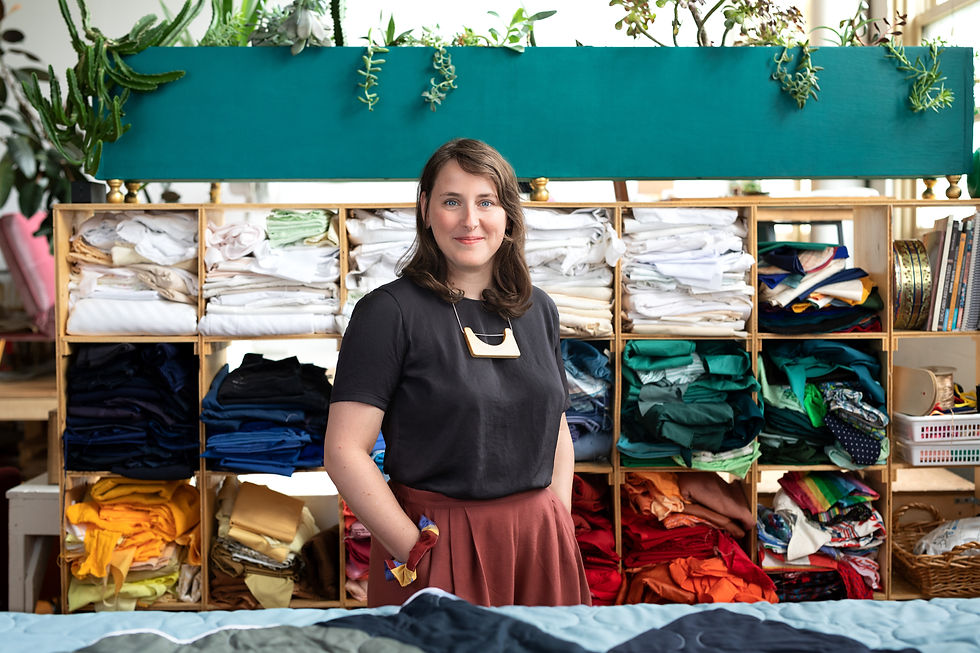
I am a contemporary quilt artist and certified professional craftswoman. My practice is rooted in a strong textile heritage and in techniques that have been passed down through generations, but I approach quilting from a contemporary, art-driven perspective.
Through precise composition and an ongoing exploration of materials, I create one-of-a-kind textile works that draw inspiration from the built and natural environments around me. I am particularly interested in how simple shapes, textures, colours and fragments can be brought together to evoke a sense of place, memory and lived experience.
All of my work is made entirely from reclaimed textiles, the majority of which are sourced from post-industrial textile waste. I see these materials not only as resources, but as carriers of stories and memories. By giving them a new life within a contemporary composition, I try to preserve something of their history while creating something entirely new.
For me, quilting is both a technical practice and a way of thinking. It allows me to explore the relationship between material, memory and place, while creating objects that are meant to endure and, ultimately, to be passed on as a legacy.

2. How did you first get into quilting?
Textiles and sewing have been part of my life for as long as I can remember. I grew up surrounded by sewing, influenced by my grandmother who was a seamstress and my aunts, so working with fabric was already familiar to me. But quilting came into my life much later.
After moving to the Eastern Townships of Quebec, I met France Verrier in 2017 through the local Cercle de fermières. That encounter introduced me to quilting and to a whole textile tradition that was new to me. I was immediately drawn to the possibilities of bringing pieces of fabric together, both technically and visually.
What began as a discovery quickly became a way of working that felt very natural to me. I became increasingly interested in the composition, structure and possibilities of the quilt as an art form, and eventually began developing my own contemporary approach to the medium.
In 2018, I founded Le Point Visible, and quilting gradually evolved from something I was discovering into the foundation of my artistic practice.
3. Where do you find inspiration for your work?
I find inspiration primarily in the environments around me, both natural and built. Living in the Eastern Townships has made me particularly attentive to the landscapes, architecture, textures and traces of human presence that surround me every day.
I am often drawn to simple things: the geometry of a building, the way light falls on a surface, a fragment of a landscape, a weathered material, or an unexpected combination of colours and textures. Photography is also an important part of my process, as it allows me to capture details and moments that can later become the starting point for a textile composition.
I am especially interested in fragments. A small detail can suggest an entire place or memory. I translate these observations into simplified shapes, layers, textures and compositions, allowing the original source to evolve into something that is no longer a literal representation, but rather an impression or interpretation of what I have seen.
The materials themselves can also become a source of inspiration. Because I work exclusively with reclaimed textiles, I often begin with what is available and let the qualities, colours and limitations of the materials influence the direction of a piece.
4. Can you walk us through your creative process, from initial idea to sourcing materials to the physical act of making?
My process can begin in several different ways. Sometimes it starts with a photograph, a place or an observation of the natural or built environment. I spend a lot of time drawing at this stage, making numerous sketches to explore shapes, proportions, relationships and composition. Drawing allows me to simplify what I see and gradually find the visual language I want to bring into the textile.
Once I arrive at a composition that feels right, I continue developing it through the materials themselves. Because I work exclusively with reclaimed textiles, the fabrics I have available become an important part of the creative process. I sort and explore them according to their colour, texture, weight, transparency and structure, and I often keep materials for a long time before knowing what they will become.
The transition from drawing to textile is not a simple translation. I continue to evolve the composition using the fabric scraps I have on hand, arranging and rearranging them until the qualities of the materials and the original drawing come together. Sometimes the textiles lead me in an unexpected direction, and I allow the composition to change accordingly.
The technique I choose depends on the project and on what I want the materials and composition to express. I work with several quilting techniques. For some pieces, I use raw-edge appliqué, while others call for different piecing or quilting approaches, particularly when creating quilts or garments. I also draw from textile traditions beyond North American quilting, such as jogakbo, a Korean patchwork technique, as well as more traditional North American piecing techniques such as tumbling blocks and improv quilting.
Left to right: Composition wall hanging. // Colour-block quilt project created in collaboration with Sid Lee creative agency. // Appalaches throw quilt. Photos courtesy of the artist.
The physical making is slow and precise. I cut, layer, appliqué, piece and quilt the textiles, paying close attention to proportion, texture, negative space and the relationship between each element. There is a constant dialogue between the initial drawing and what the materials and chosen technique actually allow me to do.
For me, that dialogue is an essential part of the process. I may begin with a clear visual intention, but the final piece is always shaped by the evolution of the drawing, the materials, the technique and the act of making itself.
5. Aside from blankets, you also make home one-of-a-kind coats, which are so interesting and unique. How did the coats come about? Did you always want to make garments?
I did not set out to become a garment designer. The coats actually came about from a very personal desire: I loved the comfort of a quilt so much that I wanted to create a coat that would give me that same feeling, something I could wear every day. So, I started making coats for myself.
As I experimented, I became increasingly interested in the possibilities of bringing my quilting practice into clothing. A coat offers a very different canvas from a quilt. It has structure, volume and movement, and the composition has to respond to the shape of the body. I enjoy the challenge of adapting quilting techniques to a three-dimensional object while keeping the textile work at the centre.
The coats are made from the same reclaimed textiles that I use in my other work, and I often incorporate different quilting and patchwork techniques depending on the piece. Each one is unique, shaped by the materials available and by the composition I want to create.
What began as a way of making myself something comfortable to wear has gradually become an important part of my practice. I love that a quilted garment can exist somewhere between art and everyday life, it is a textile piece that can be worn, moved in and lived with.

6. In what ways do you use your practice and techniques to push conventional boundaries?
I don't necessarily think about my work in terms of pushing the boundaries of quilting. I see quilting primarily as a medium of expression rather than an end in itself. My background is quite different from that of a traditional quiltmaker. I studied international relations at the graduate level before dedicating myself to textile art, and perhaps that has influenced the way I approach the medium.
For me, textile work is a way of expressing ideas visually and materially. In some ways, it feels more intuitive to me than painting. I enjoy the constraints that come with sewing and working with fabric because they give me problems to solve. I approach a piece almost like a puzzle: I am constantly figuring out how different elements can come together and how to overcome a technical or structural challenge.
I actually enjoy beginning projects without knowing exactly how I will make them work. Sometimes I have an idea that I am not even sure is technically possible, but my instinct is to think, “I'll find a way.” Rather than seeing a constraint as a reason to stop, I see it as an invitation to find a solution.
That mindset gives me a great deal of freedom. The techniques and traditions of quilting provide a framework, but I don't feel limited by them. If a project requires me to combine techniques, adapt a traditional method or invent a new solution, I will. The problem-solving is not separate from the creative process, it is part of what makes the process exciting for me.
7. Tell us about a favourite piece (or maybe just a piece you really loved – we know it’s hard to choose!) you’ve created and why it’s so memorable.
One piece that is particularly memorable to me is Fragment de la Mitis, a 72-by-96-inch textile wall piece I created in 2025 for collector James O’Sullivan. Its story is a perfect example of how unexpected encounters can shape my work.
I met James at the Toronto Outdoor Art Fair. He had been looking for a textile wall piece and gave me an extraordinary gift as an artist: complete creative freedom; [he had] only two guidelines: natural colours and yellow. A few days later, while visiting the Melba House, I was shown a large broken window. A thermal fracture caused by an impurity in the glass had created a striking butterfly-shaped crack. I photographed it from different angles and became fascinated by its combination of chaos, movement and structure.
Then a close friend and photographer, Éliane Cadieux, returned from Métis-sur-Mer with a series of photographs. One image immediately caught my attention. Its palette: ochre yellow, sandy beige, moss green and soft grey was exactly what I had been imagining. I used the photograph as the starting point for the composition, digitally cutting, layering and simplifying the image to translate it into a textile language.
The complexity and fluidity of the composition led me to explore raw-edge appliqué. I had not worked this way before, but the technique allowed me to preserve the curves and fragmentation of the image in a way that other quilting techniques could not. The piece was then entirely free-motion quilted by machine, by hand, with each section requiring hours of careful work.

What makes this piece especially meaningful to me is that it became more than the work I had originally set out to create. It brought together a collector's trust, a broken window, a photograph, a landscape and an unfamiliar technique, and ultimately opened a new direction in my own practice. It reminded me how much I value the unexpected in the creative process and how a constraint, a chance encounter or even a technical problem can lead somewhere I could not have planned.
8. What have you encountered in your career so far that readers (or other artists) might find surprising or unexpected?
Perhaps the most unexpected part of my career has been discovering that quilting would become my profession. Before becoming a quilt artist, I completed a master's degree in international relations. I never imagined that I would eventually make a living from quilting, but I always knew that textiles would remain part of my life. I knew I would always be making things with fabric and keeping textiles close to me in some way.
What surprised me even more was discovering how much intellectual and expressive space there is within a material practice. I initially thought of quilting as something very different from the kind of work I had done before, but I quickly realized that it offered many of the things I enjoy most: observation, analysis, problem-solving, research and finding connections between seemingly unrelated elements.
My values and principles have also naturally found their way into my practice, which allows me to maintain a connection with the social and political questions that have always interested me. Quilting has a long history as a domestic and often women-centred practice, and I am interested in what happens when this form of making moves into the public sphere. I see quilting as a powerful way of democratizing textile art and of bringing a practice that has often been associated with women's private and domestic spaces into a contemporary artistic context.
Left to right: Une question de perspective quilt throw // Silice quilt throw // Casa Barragan quilt throw. Photos courtesy of the artist.
I have also been surprised by how often unexpected opportunities have shaped my practice. Some of the most important developments in my work have come from saying yes to a project before knowing exactly how I would accomplish it. Fragment de la Mitis, for example, began with a very open commission and a series of completely unexpected encounters, and ultimately introduced a technique that opened a new direction in my work.
Another unexpected discovery has been how much I enjoy the entrepreneurial side of being an artist. I genuinely enjoy building the business around my creative practice: developing projects, finding opportunities, connecting with people and figuring out how to make the different pieces work together. I think that combination of creativity and entrepreneurship has helped me build a sustainable career and make a living from quilting for the past eight years.
There is something that still makes me smile about saying that I have made a living from quilting for eight years. It may not be the career people immediately imagine when they think of quilting, but for me, the artistic, entrepreneurial and social dimensions of the practice are closely connected.
I think that has become one of the most valuable lessons of my career: you do not always need to know exactly where your practice is going. Sometimes the most interesting things happen when you follow a curiosity, accept a challenge and figure out the rest along the way.
9. In what ways do you hope your own practice continues to evolve?
I don't necessarily want my practice to keep growing in size. In fact, over the past few years, I have intentionally chosen to make my business smaller and more focused. I have become more interested in doing fewer things, but making sure that the things I do have meaning and that they align with what matters most to me.
Artistically, I want to create space for larger and more challenging pieces, as well as projects that allow me to explore without necessarily knowing where they will lead. I would like to develop collections and bodies of work, pursue residencies and exhibitions, and give myself more opportunities to experiment and go deeper into an idea.
Finding a balance between my artistic practice, my business and my personal and family life is also an important part of this evolution. For me, a successful practice is not simply one that grows. It is one that allows me to create meaningful work while leaving room for the other parts of my life that matter.
Ultimately, I want to be more intentional about where I put my time and energy. I want to take on projects that challenge me, that have something to say, or that simply make me curious, and to have the freedom to say no to the things that don't. I see this as less about growing my practice and more about making it more focused, meaningful and sustainable.

10. Pay it forward -- tell us about something or someone our readers should know about.
I would like to use this opportunity to draw attention to textile art and, more broadly, to the work of women artists. Textile practices have a long and rich history, yet they are still not always given the same visibility or recognition as other forms of contemporary art. This is even more striking when we consider how much of this knowledge and creative work has historically been carried out by women, often within the private and domestic sphere.
I believe that textile art deserves to be seen, discussed and exhibited as a contemporary artistic practice in its own right. For me, bringing quilting into galleries, exhibitions and public spaces is part of that work. It is a way of making visible both the artistic possibilities of the medium and the knowledge, creativity and labour that have traditionally been associated with women's work.
I would encourage readers to seek out textile artists, especially women whose work may not always receive the visibility it deserves. There is an extraordinary breadth of contemporary textile practices happening today, and I think we all benefit when we take the time to look beyond the mediums that have traditionally occupied the centre of the art world.


Comments